
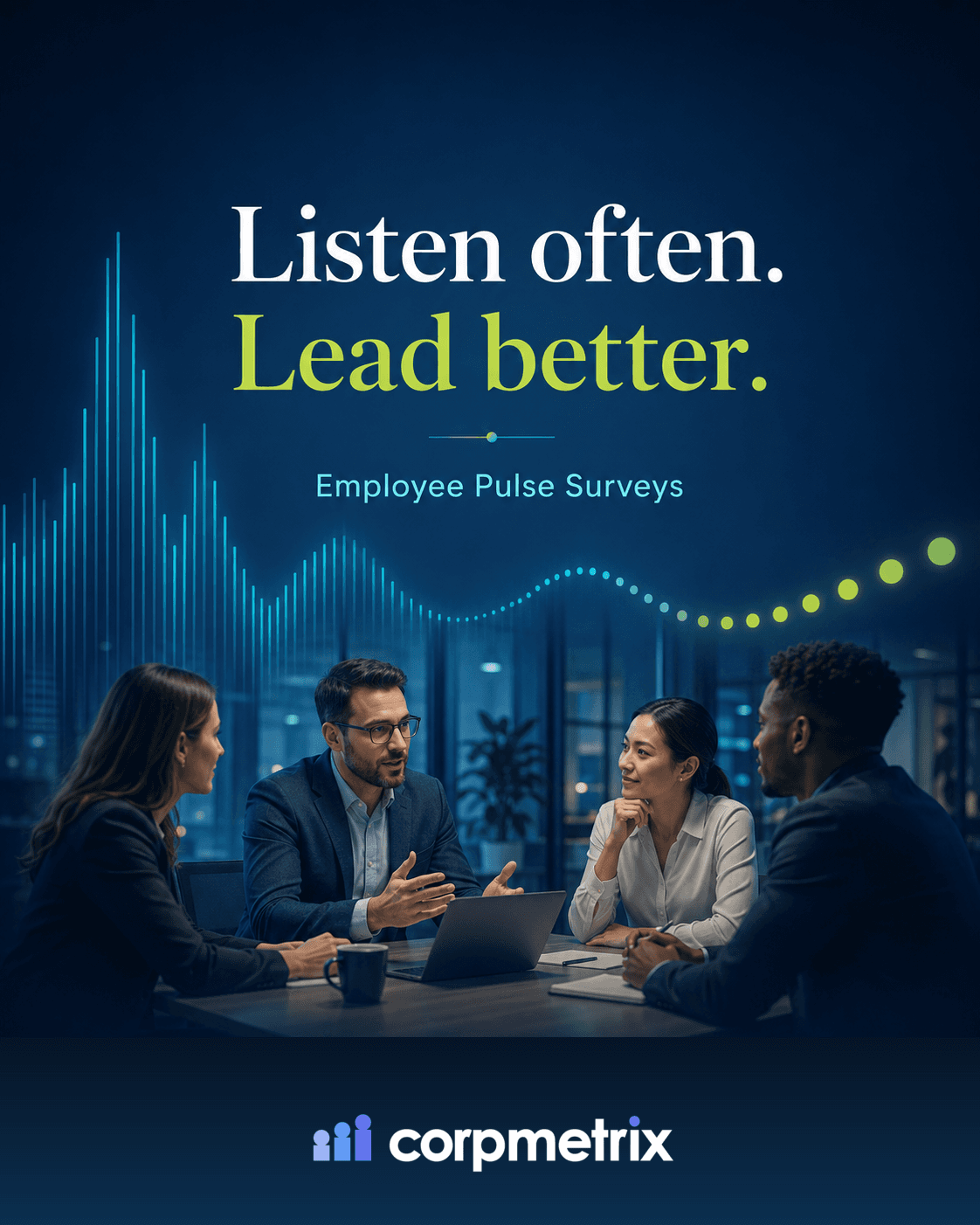
What a pulse survey is — and is not
A pulse is a brief listening instrument, typically five to fifteen items, run monthly or quarterly against a stable core. It is not a replacement for a deep PEACE® engagement programme, and it is not an always-on chat that never closes. The value is trend continuity: the same PEACE® model, revisited often enough that managers can act while issues are still small.
Corpmetrix® pulse programmes sit on the same PEACE® model as the annual engagement survey, so a mid-year change can be read against the last full cycle.

When continuous listening earns its place
Pulses pay off after transformation, reorganisation, or rapid hiring — moments when annual timing alone arrives too late. They also help multi-site employers watch branch or market climate between full fieldwork waves. If nothing material is changing and leaders still cannot close actions from the last survey, fix the action loop first; more questionnaires will not help.
- After major change: confirm whether direction and clarity held for the teams most affected.
- Between annual cycles: track two or three priority drivers with a short, stable item set.
- Before the next deep survey: use a pulse to validate whether prior actions moved the needle.
Design rules that protect trust and signal
Keep the core identical across waves so leadership reads a trend, not a reboot. Rotate only a thin topical slice. State anonymity and k-thresholds as clearly as you would for an annual survey. Prefer channels people already use — email, SMS, WhatsApp, QR — especially for deskless teams. And always publish what changed since the last pulse; silence teaches people that answering is optional theatre.
From pulse scores to owned next steps
A pulse without owners is noise. Route heatmaps to the same manager scorecards used after engagement fieldwork. Cap each team on one or two commitments. Close the loop with a short “you said / we did” note before the next wave. That rhythm — listen, prioritise, act, prove — is what turns continuous listening into retention and performance signal rather than another PDF.
Frequently asked questions
How often should we run pulse surveys?
Quarterly is a common enterprise cadence; monthly can work for short, stable cores during change. If action quality drops, slow the cadence — frequency without follow-through erodes trust.
Should pulses use the same model as the annual engagement survey?
Yes when possible. The same PEACE® model lets leaders compare mid-year pulses to the annual baseline without relearning a second survey.
Can pulses replace the annual engagement survey?
No. Pulses track movement on a thin set of items. Annual (or deep periodic) programmes remain the place for full PEACE coverage, benchmarks, and richer comment intelligence.